The visible auction
ORDER FLOW Market Mechanics
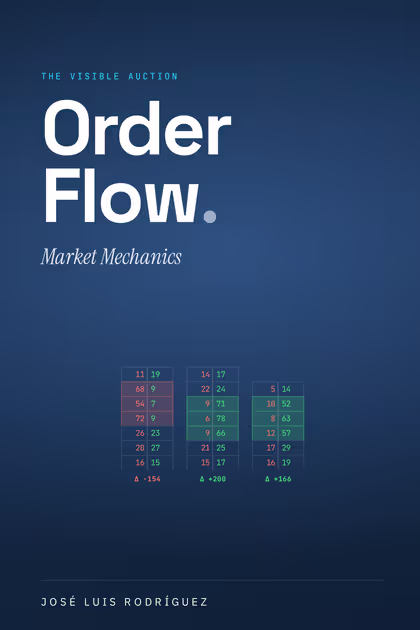
The chart shows price. Order flow shows the reason. A three-layer decision framework — session narrative, structure and Footprint confirmation — applied to CME futures.
- pages
- 484 pages
- chapters
- 20 chapters
- setups
- 9 setups
Paperback · $49.95 / €44.95 depending on marketplace
Who this book is for
You know how to read candles. You identify levels. You wait for confirmation. You manage risk. You log every trade. You do everything you are supposed to do, and for a while it is enough.
But situations start piling up that do not fit the model: the support that should have held and does not, the breakout that should have continued and reverses instead. What is unsettling is not losing. It is not finding the cause.
This book is for you if
- You trade classical technical analysis and keep hitting failures the model cannot explain.
- You have added indicators, switched timeframes and tweaked parameters without the results improving to match.
- You want to understand why price stops where it stops, not memorise another pattern.
- You trade, or want to trade, CME futures — the NQ in particular — with depth and volume-at-price data.
It is not for you if
- You are looking for a closed signal system that requires no interpretation or context.
- You expect a promise of profitability or a guaranteed win rate. There is none here.
- You are not willing to work with paid market data and a platform that displays Footprint.
- You want a general introduction to trading: this book assumes you have already covered that ground.
Works with any platform that displays Footprint
- ATAS
- Bookmap
- Sierra Chart
- NinjaTrader
The book explains the reading, not a specific platform. These names are listed for reference only; there is no commercial relationship with any of them.
Key concepts
Six pieces of market microstructure a candlestick chart does not show, developed one by one throughout the book.
- 01
Footprint
The X-ray of the auction: how much volume trades at each price and how it splits between buying and selling aggression inside every candle.
- 02
CVD
Cumulative delta. The longitudinal context of effort: whether aggressive pressure is sustaining the move or exhausting itself while price holds.
- 03
Absorption
The measure of result. Aggressive volume hitting passive orders and failing to move price. Where it is tradable and where it is not.
- 04
Spoofing
False and hidden liquidity. How to tell an iceberg from an order pulled before it fills, and what each one implies for your reading.
- 05
Imbalances
The microstructure of urgency. Diagonal imbalances between bid and ask, when they stack, and why an isolated imbalance means nothing.
- 06
Volume Profile
The map that precedes the flow: session and composite profiles, HVN and LVN, and the hierarchy of levels that decides where acting makes sense.
What is inside
Six parts, twenty chapters, nine trading setups and two appendices. This is the book's actual table of contents.
- Part I
The Paradigm Shift
- 1 — The Silent Failure of Classical Technical Analysis
- 2 — The Market as an Auction: The Missing Piece
- Part II
The Reading Framework
- 3 — Three Layers: The Book's Core Decision Model
- 4 — The Session Narrative: Reading What the Market Is Trying to Do
- Part III
The Method: From the Map to the Flow
- 5 — The Map: The Levels That Matter Before You Look at the Footprint
- 6 — Confirmation: What the Flow Must Show When the Story Fits
- 7 — Volume, Liquidity and High-Volatility Context
- Part IV
The Setups: Where the Method Becomes Operational
- 8 — Setup 1: Stacked Imbalances, the Signature of Institutional Urgency
- 9 — Setup 2: Absorption and Break of Structure
- 10 — Setup 3: Aggressor Trap at the Extreme
- 11 — Setup 4: False Breakout with Absorption
- 12 — Setup 5: Continuation on Pullback with Absorption
- 13 — Setup 6: Rejection at the HVN
- 14 — Setup 7: LVN Acceleration
- 15 — Setup 8: Exhaustion Impulse
- 16 — Setup 9: Incomplete Auction Closure
- Part V
The Professional Trader
- 17 — The Three Roles: Researcher, Executor, Auditor
- 18 — Self-Destruction: The Psychological Side of the Footprint
- 19 — The Lethal Mistakes of Order Flow
- Part VI
What Order Flow Does Not Give You
- 20 — The Real Limits of Flow Analysis
Also included
- Prologue — When Technical Analysis Stops Working
- Epilogue — The Small Trader's Real Advantage
- Appendix A — Glossary of Microstructure Terms
- Appendix B — Pre-Session Preparation and Post-Session Review Checklists
Free sample
The prologue and the first five chapters in full, as a PDF. No form, no email, no sign-up. Download it and judge for yourself.
The same quality test you would apply to any book in a bookshop: open it and read.
Format and edition details
- Format
- Paperback
- Pages
- 484
- Dimensions
- 6 × 9 in (15.24 × 22.86 cm)
- Language
- English
- ISBN
- 9798171900076
- First edition
- September 6, 2026
- Price
- $49.95 / €44.95
Final price and availability depend on the Amazon marketplace you buy from.
View on AmazonWhy this book exists
There is a point where the logic of technical analysis starts to crack. I am not talking about a bad streak or an execution error, but about something harder to diagnose: situations that do not fit the model, with uncomfortable regularity.
This book does not come from theory. It comes from years of trading the same approach, adding indicators, switching timeframes, tweaking parameters. The method kept getting refined; the results did not improve to match. Every time the missing adjustment seemed to have finally been found, the market proved otherwise.
The problem was not execution. It was the instrument. Technical analysis has a limit that is rarely stated clearly, and that limit is not overcome by optimising rules, but by understanding what part of the market the model is leaving out.
The purpose of these pages is to show where that limit is and what lies on the other side. Not more patterns or more confirmation tools, but an operational explanation of the underlying mechanics: why price moves, why it stops where it stops, why it cuts through levels that looked solid on the chart.
Technical analysis did not fail you for lack of rigour. It failed you for lack of information.
José Luis Rodríguez
Author page on AmazonFrequently asked questions
Do I need prior knowledge?
Yes. The book assumes you already trade, or have traded, using technical analysis and that you know the basics of intraday execution. It is not an introduction to trading: it starts exactly where classical technical analysis falls short.
Does it work for stocks, forex or crypto?
The book works on CME futures, the NQ in particular, because they are centralised markets where volume at each price is real and auditable. The logic of the auction transfers to other markets; the quality of the data does not. In decentralised markets, the volume you see is not the volume that exists.
What platform do I need?
Any platform that displays Footprint and volume profile, with market data that includes volume traded at each price. The book explains the reading, not the handling of a specific program, so it does not go stale when you switch tools.
Does it promise results or a win rate?
No, and that is worth stating plainly. The book devotes its final part to the limits of the method: order flow does not predict, it records; it does not anticipate, it confirms; it does not eliminate risk, it quantifies it; it does not give certainty, it gives well-founded probability. Any material promising you otherwise is selling something else.
How many setups are included and how are they explained?
Nine, one per chapter, from chapter 8 to chapter 16. Each with its context of application, objective entry conditions, invalidation conditions, and the cases where the setup is not tradable even though it looks like it is.
Is there a Kindle edition?
Not at the moment. Paperback only. The book leans on Footprint charts and volume tables that read better on paper at 6 × 9 inches.
How do the English and Spanish editions differ?
They are two independent editions of the same book, each with its own ISBN and its own Amazon listing. The content is the same; the language changes and, because of typesetting, so does the page count.
What does it cost and where can I buy it?
On Amazon only, in paperback. The price is $49.95 in the United States and €44.95 across the European marketplaces; other countries may differ. Amazon will show you the price for your local store.