The visible auction
ORDER FLOW Market Mechanics An order flow trading book
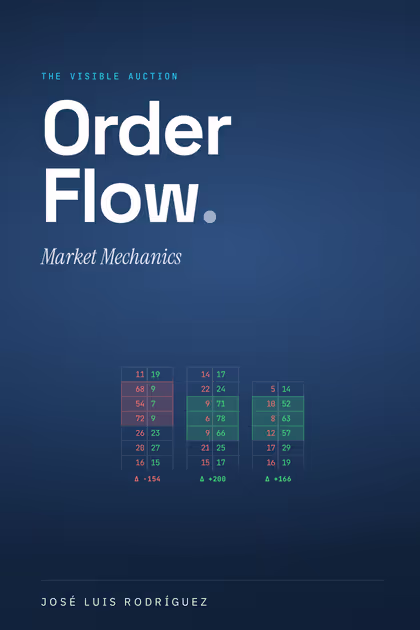
A technical order flow trading book for anyone trading futures on a centralised order book, such as indices, currencies, commodities or interest rates, with the examples centred on NQ. The chart shows price; order flow shows the reason. The book organises that reading into a three-layer decision framework: session narrative, structure and Footprint confirmation.
- pages
- 484 pages
- chapters
- 20 chapters
- setups
- 9 setups
Paperback · $49.95 / €44.95 depending on marketplace
Who this book is for
You know how to read candles and identify levels. You wait for confirmation, manage risk and log every trade. You do everything you are supposed to do, and for a while it is enough.
But situations start piling up that do not fit the model: the support that should have held and does not, the breakout that should have continued and reverses instead. What is unsettling is not being able to find the cause.
This book is for you if
- You trade classical technical analysis and keep hitting failures the model cannot explain.
- You have added indicators, switched timeframes and tweaked parameters without the results improving to match.
- You want to understand why price stops where it stops.
- You trade, or want to trade, futures on a centralised order book, with depth and volume-at-price data. The examples in the book use NQ.
It is not for you if
- You are looking for a closed signal system that requires no interpretation or context.
- You expect a promise of profitability or a guaranteed win rate: the book offers neither.
- You are not willing to work with paid market data and a platform that displays Footprint.
- You want a general introduction to trading: this book assumes you have already covered that ground.
Works with any platform that displays Footprint
- ATAS
- Bookmap
- Sierra Chart
- NinjaTrader
- Quantower
- MotiveWave
- OverCharts
The book teaches the reading on any of them. These names are listed for reference only; there is no commercial relationship with any of them.
Key concepts
Six pieces of market microstructure a candlestick chart does not show, developed one by one throughout the book.
Before the concepts, the mechanics: what order flow is and what it records.
- 01
Footprint
The X-ray of the auction: how much volume trades at each price and how it splits between buying and selling aggression inside every candle.
- 02
CVD
Cumulative delta. The longitudinal context of effort: whether aggressive pressure is sustaining the move or exhausting itself while price holds.
- 03
Absorption
Aggressive volume hitting passive orders and failing to move price. When it is tradable and when it is not.
- 04
Spoofing
False and hidden liquidity. How to tell an iceberg from an order pulled before it fills, and what each one implies for your reading.
- 05
Imbalances
Diagonal imbalances between bid and ask that signal urgency: when they stack, and why one on its own is rarely enough.
- 06
Volume Profile
The map that precedes the flow: session and composite profiles, HVN and LVN, and the hierarchy of levels that decides where acting makes sense.
What is inside
Six parts, twenty chapters, nine trading setups and two appendices. This is the book's actual table of contents: expand any chapter to see its sections.
The prologue and chapters 1 to 5 are included in full in the free sample. See what the sample includes
- Part I
The Paradigm Shift
-
1. The Silent Failure of Classical Technical Analysis In the sample
- The mental model we were taught — and its founding flaw
- The illusion of visual control
- Why institutions don’t trade what you trade
- The final fracture: when support stops being support
- The disciplined trader who doesn’t progress
-
2. The Market as an Auction: The Missing Piece In the sample
- The microstructure the chart hides
- What actually moves price: passive orders and aggressive orders
- How a Footprint is built — the X-ray of the auction
- Why a breakout doesn’t mean anything by itself
- How your reading changes once you understand the auction
-
- Part II
The Reading Framework
-
3. Three Layers: The Book's Core Decision Model In the sample
- Layer 1 — The session narrative: what the market is trying to do today
- Layer 2 — Structure: where it makes sense to act
- Layer 3 — The Footprint’s micro-confirmation
- The universal mistake: trading Layer 3 without context
- How a professional trader makes decisions
-
4. The Session Narrative: Reading What the Market Is Trying to Do In the sample
- Phases of the intraday auction and their transitions
- The Initial Balance as the day’s thermometer
- Trend days, rotational days, and no-opportunity days
- How to build a hypothesis before the market opens
- What invalidates a hypothesis, and when to abandon it
-
- Part III
The Method: From the Map to the Flow
-
5. The Map: The Levels That Matter Before You Look at the Footprint In the sample
- Volume profile: session vs. composite
- Macro institutional levels: Settlement, PDH/PDL, VWAP, ONH/ONL, Weekly H/L
- High-value institutional zones: confluence and hierarchy
- When the Footprint is signal and when it’s noise
- Building the trading plan before the market opens
-
6. Confirmation: What the Flow Must Show When the Story Fits
- Delta: the measure of effort
- Absorption: the measure of the result
- CVD: the longitudinal context of effort
- Imbalances: the microstructure of urgency
- The Footprint as an instrument of confirmation
-
7. Volume, Liquidity and High-Volatility Context
- Normal, anomalous and climactic volume
- Hidden liquidity and false liquidity: Iceberg and Spoofing
- Why the Footprint changes during macro news
- Forced liquidity: what you are really seeing in an event
- Trading protocol: when to trade and when to close the platform
-
- Part IV
The Setups: Where the Method Becomes Operational
- 8. Setup 1: Stacked Imbalances, the Signature of Institutional Urgency
- 9. Setup 2: Absorption and Break of Structure
- 10. Setup 3: Aggressor Trap at the Extreme
- 11. Setup 4: False Breakout with Absorption
- 12. Setup 5: Continuation on Pullback with Absorption
- 13. Setup 6: Rejection at the HVN
- 14. Setup 7: LVN Acceleration
- 15. Setup 8: Exhaustion Impulse
- 16. Setup 9: Incomplete Auction Closure
Every setup is developed in the same order: context, structure, footprint, execution, failure and invalidation.
-
- Part V
The Professional Trader
-
17. The Three Roles: Researcher, Executor, Auditor
- Separating analysis from execution
- Why retail fails when it mixes roles
- The process before, during and after the trade
- Building consistency from the process, not from the result
- The flow journal as an instrument of improvement
-
18. Self-Destruction: The Psychological Side of the Footprint
- The problem of micro-analysis and cognitive load
- Footprint overconfidence: the crystal ball syndrome
- Overtrading: when seeing more makes you do more
- Analysis paralysis: the noise of confirmation
- Discipline based on evidence, not on emotion
-
19. The Lethal Mistakes of Order Flow
- Trading flow without structure: the mistake that contains all the others
- Confusing delta with direction
- Trading absorptions that are not tradable
- Overvaluing isolated imbalances
- Trading macro events without a protocol
- Trading the NQ without watching the ES: the mistake of isolating the index from its context
- Overtrading from an excess of visible signals
- How three mistakes chain together in one morning
- Classification of mistakes by severity
-
- Part VI
What Order Flow Does Not Give You
-
20. The Real Limits of Flow Analysis
- It does not predict: it records
- It does not anticipate: it confirms
- It does not eliminate risk: it quantifies it
- It does not replace context: it requires it
- It does not give you certainty: it gives you well-founded probability
- Closing
-
Also included
- Prologue: When Technical Analysis Stops WorkingIn the sample
- Epilogue: The Small Trader's Real Advantage
- Appendix A: Glossary of Microstructure Terms
- Appendix B: Pre-Session Preparation and Post-Session Review Checklists
Free sample
The prologue and the first five chapters in full, as a PDF. It downloads straight away, with no email and no sign-up.
What the sample includes Or read it on Amazon
The same quality test you would apply to any book in a bookshop: open it and read.
Format and edition details
- Format
- Paperback
- Pages
- 484
- Dimensions
- 6 × 9 in (15.24 × 22.86 cm)
- Language
- English
- ISBN
- 9798171900076
- First edition
- 6 September 2026
- Price
- $49.95 / €44.95
Final price and availability depend on the Amazon marketplace you buy from.
View on AmazonWhy this book exists
There is a point where the logic of technical analysis starts to crack. I mean something harder to diagnose than a bad streak or an execution error: situations that do not fit the model, with uncomfortable regularity.
This book comes from years of trading the same approach and adjusting it again and again. The method kept getting refined; the results did not keep up. Every time the missing adjustment seemed to have finally been found, the market proved otherwise.
What was failing was the instrument. Technical analysis has a limit that is rarely stated clearly, and getting past it means understanding what part of the market the model leaves out. Optimising rules is not enough.
The purpose of these pages is to show where that limit is and what lies on the other side: an operational explanation of why price moves, why it stops where it stops and why it cuts through levels that looked solid on the chart.
Technical analysis did not fail you for lack of rigour. It failed you for lack of information.
José Luis Rodríguez
About the authorFrequently asked questions
Do I need prior knowledge?
Yes. The book assumes you already trade, or have traded, using technical analysis and that you know the basics of intraday execution. It starts exactly where classical technical analysis falls short.
Does it work for stocks, forex or crypto?
It works for any futures contract on a centralised order book: indices, currencies, commodities or interest rates. The examples use CME futures, the NQ in particular, because on a centralised market the volume at each price is real and auditable. That is also the limit: in spot forex, which has no centralised book, and in markets split across several venues, such as much of crypto or stocks that also trade away from the exchange, the volume you see is not the volume that exists.
What platform do I need?
Any platform that displays Footprint and volume profile, with market data that includes volume traded at each price. The book teaches the reading itself, independent of any program, so it does not go stale when you switch tools.
Does it promise results or a win rate?
No. The final part of the book is about the limits of the method: order flow records what has already happened, helps you confirm or reject a hypothesis and helps you quantify risk, but it does not remove risk or give certainty. Be wary of any material that promises otherwise.
How many setups are included and how are they explained?
Nine, one per chapter, from chapter 8 to chapter 16. Each with its context of application, objective entry conditions, invalidation conditions, and the cases where the setup is not tradable even though it looks like it is.
Is there a Kindle edition?
Not at the moment. Paperback only. The book leans on Footprint charts and volume tables that read better on paper at 6 × 9 inches.
How do the English and Spanish editions differ?
They are two independent editions of the same book, each with its own ISBN and its own Amazon listing. The content is the same; the language changes and, because of typesetting, so does the page count.
What does it cost and where can I buy it?
On Amazon only, in paperback. The price is $49.95 in the United States and €44.95 across the European marketplaces; other countries may differ. Amazon will show you the price for your local store.